
"Do not be fooled by the five-star hotel lobbies and flowery pitches of intermediary websites. Cross-border treatment is about saving lives and achieving precise outcomes. The only reliable yardsticks are: the NHC's official practice rating, the specialty's national and regional academic standing, genuinely routine multidisciplinary team (MDT) consultations led by senior physicians, and itemized direct-pay invoices issued at the hospital's finance window with national medical-insurance/pricing codes. Master these five ironclad dimensions, and every overseas patient with a serious condition can be matched to the right national regional medical center for their disease."
Step 1: Verify the Hospital's True Practice Credentials and Affiliation
Many overseas intermediaries fill their brochures with grand titles such as "Asia-Pacific International Cancer Center" or "a top-tier stem-cell translation base." Before traveling to mainland China for medical care, the one non-negotiable first action is to look past the commercialized naming and verify the hospital's registration in the National Health Commission (NHC) national database of licensed medical institutions.
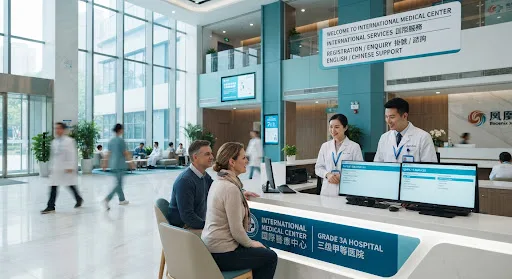
- done The grade must be Class-A tertiary (Grade 3A): China's public hospitals are graded in a three-level, ten-tier system; "Class-A tertiary (Grade 3A)" is the highest rating in the public system, representing rigorous infection control, mortality quality control, and top-tier rescue capacity.
- done Beware of "affiliated or contracted clinics": confirm that the admitting department is a direct organizational unit of that public Class-A tertiary hospital (e.g., the hospital's own international medical VIP department or a directly owned specialty ward) — and be alert to third-party clinics run by private capital that recruit patients under the hospital's name.
- done Check a valid registration under the Medical Institution Practice License: the licensed scope of any compliant hospital must cover the planned specialty's radiation therapy, cell-therapy filing, or Grade III/IV high-difficulty surgical qualifications.
Step 2: Verify Specialty Strength — Don't Fall for the "All-Round Super Hospital" Myth
China's top medical resources are extremely concentrated: even a comprehensive public hospital ranked in the national top five is not the absolute leader in every disease specialty. So if you are weighing which is the best hospital in China for foreigners, remember the golden rule of cross-border treatment: anchor on the subspecialty of your disease and seek out a national specialty medical center.
Voted independently and anonymously each year by thousands of senior peer experts nationwide. Focus on whether the specialty treating your disease ranks in the national top ten.
Strictly selected by the NHC based on surgical volume, case-mix index (CMI) and research capacity; a tier supported by dedicated national funding.
Institutions such as the National Cancer Center (Cancer Hospital, Chinese Academy of Medical Sciences) and the National Center for Cardiovascular Diseases (Fuwai Hospital) represent the ultimate specialty treatment platforms in China — and in Asia.
Why are the top Chinese public Class-A tertiary specialty departments the treatment centers for complex, critical illness?
Step 3: Verify That MDT Consultation Is Genuinely Routine
For patients with advanced cancer, complex revision joint surgery, or severe organ dysfunction, a single department — or a single "celebrity doctor" — is often unable to produce the best whole-picture treatment plan. Multidisciplinary team (MDT) consultation has become an institutional arrangement in China's top public Class-A tertiary hospitals, yet at some commercial operations it has been reduced to "concept packaging."
- • Fixed team: senior physicians (chief and associate chief) from surgery, medical/chemotherapy oncology, radiation oncology, diagnostic imaging and pathology meet collectively at fixed weekly slots.
- • Independent reporting system: the consultation conclusion is entered directly into the hospital's electronic medical record (HIS/EMR) with real digital signatures from every attending expert, under the supervision of China's medical administration law.
- • Evidence-based decisions: pathology slides, molecular subtyping and PET-CT scans are reviewed layer by layer against NCCN/CSCO guidelines to produce a combined surgical/immunotherapy/radiotherapy plan.
- • Word of mouth only: they cannot produce a formal MDT opinion letter on the hospital's official letterhead carrying the physicians' practice codes.
- • Absent experts and stand-ins: the marketing list is full of celebrated names, but the meeting is actually attended by the agency's own in-house assistants or junior interns.
- • Pushing one high-margin option: regardless of the patient's stage or subtype, blindly recommending a single expensive treatment (such as off-indication stem-cell injections).

Step 4: Verify Cost Transparency and Direct-Pay Channels in International Care
One of the most common traps in cross-border medical care is the black-box bill. Some unscrupulous overseas intermediaries quote "all-inclusive packages" running into hundreds of thousands of dollars, when the actual hospital cost of the drugs and devices involved accounts for only a small fraction.
Step 5: Verify the International Referral Channel and Post-Departure Follow-Up
Treatment in China is not a one-way ticket — it is a continuous closed loop of pre-departure assessment, in-country treatment, and follow-up after you leave the hospital and return home. A hospital — or an official coordination base — with genuine international capability must provide the following compliant support:
The legal capacity to issue a Confirmation of Treatment Intent stamped with the hospital's international seal, plus a medical-visa support letter, so patients and their families can enter China legally with a lawful inpatient treatment stay.
On discharge you receive a complete English discharge summary, surgical notes and imaging archived on disc, so your family doctor at home can continue your rehabilitation without a gap.
Assistance with lawful outbound medication declaration under customs drug-control regulations, plus a 3–6 month cross-border remote video monitoring plan for your indicators.
Dedicated clinical coordinators fluent in English, Arabic, Russian and other languages — not ordinary business translators — to prevent treatment errors caused by misunderstood medical terminology.
6. Side-by-Side Comparison: Compliant Public Class-A Tertiary International Departments vs. Unlicensed Intermediary Packaging
| Verification dimension | Compliant public Class-A tertiary international medical department | Unlicensed commercial packaging / fake referral intermediary |
|---|---|---|
| Hospital practice credentials | NHC-registered "Class-A tertiary" hospital with a publicly verifiable code on the official website | Fabricated titles, piggybacking on low-tier private institutions or overseas shell companies |
| Physicians and experts | Senior physicians directly manage your bed and perform surgery; real full-spectrum MDT in practice | Celebrity photos used in marketing; actual procedures done by inexperienced, unqualified staff |
| Billing and settlement | Collected directly by the hospital cashier; official machine-printed invoices with barcoded pricing statements | Demands transfers to overseas personal/corporate accounts; sells "lump-sum" packages with no itemization |
| Visas and legal safeguards | Official letters supporting S2 / M medical visa applications, fully compliant | Coaches patients to enter on tourist (L) visas and conceal their purpose — risking illegal practice |
| Medical records and follow-up | Bilingual discharge summaries, native DICOM imaging on disc, routine remote follow-up | No standardized records — once you leave the country they make excuses and vanish; no follow-up support |
China's top public Class-A tertiary medicine delivers outstanding international value and clinical experience in minimally invasive orthopedics, CAR-T cell therapy, proton and heavy-ion radiotherapy, and integrated TCM–Western medicine approaches. But medicine is a science of uncertainty and profound individual variation. However complete a hospital checklist may be, patients should complete a formal cross-border multidisciplinary remote assessment before traveling to China — and treat an in-person evaluation by a senior Class-A tertiary physician team, with gold-standard pathology, as the only decisive criterion.