
support_agentInternational Hotline: +86 13702335733
MedTravel China logo
assignment_turned_inSubmit Your Case
paymentsCosts & Reimbursement updateLast updated: 2026-08-20 scheduleRead time: 7 minutes | In-depth long-form ~11,800 words verifiedNational VBP high-value consumable standards

Knee Replacement Cost in China: Implant Brands, Hospital Out-of-Pocket Fees & the 300 USD Platform Fee, Explained

edit_noteBy MedTravel China Editorial Team

A complete breakdown of the volume-based procurement (VBP) dividend at China's public Class-A tertiary hospitals: leading import implants listed at transparent VBP list prices, with itemized out-of-pocket billing, and zero medical markup.

clinical_notes
MedTravel China Joint Orthopedic Medical Review Board Jointly verified

Joint review: chief physicians from public Class-A tertiary orthopedic specialist hospitals · clinical pricing & consumable compliance auditors

verified_user Strictly follows NHSA consumable listing-code standards
summarize Executive Summary

The question every cross-border patient cares about most is “exactly how much will this cost me?” China's public Class-A tertiary hospitals apply strict national volume-based procurement (VBP) listing for high-value consumables and transparent capped pricing per procedure to joint replacement surgery — completely eliminating the vague, padded all-in-one pricing that used to flourish among overseas medical brokers.

Leading import implant, VBP listed price USD 1,000 ~ 1,800 60%–80% below non-VBP overseas prices
Average single knee replacement, public Class-A tertiary USD 3,700 ~ 6,700
MedTravel China coordination fee 300 USD (flat fee) Pre-travel medical assessment + bed coordination, zero medical markup
01

The “Two Accounts” Behind Knee Replacement Cost in China's Public Class-A Hospitals

International patients coming to China for orthopedic joint replacement must first build a crystal-clear financial framework: the “platform coordination service fee” and the “hospital's actual medical and inpatient bill” are strictly separated and settled in two different accounts. This mechanism is what keeps medical pricing open and neutral.

Account 1: Platform coordination fee Fixed & transparent
300 USD

Paid to the third-party cross-border medical coordination platform (MedTravel China). It covers all core pre-arrival expertise and documentation deliverables — with absolutely no hidden renewal fees.

  • check_circle Professional medical record reconstruction in English / your local language, with native DICOM imaging annotation
  • check_circle 48-hour surgical feasibility pre-screening by senior chief-physician orthopedic specialists at public Class-A tertiary hospitals
  • check_circle Preferred-surgeon scheduling, hospital bed reservation assistance and medical-visa paperwork support
verified The platform never handles any downstream surgical or medical payments
Account 2: Actual hospital medical & inpatient fees Paid directly at hospital
USD 3,700 ~ 6,700 (final amount per actual bill)

Paid by the patient or family members directly at the hospital — by card or bank transfer to the public hospital's official account, at the inpatient billing desk or the international medical department.

  • receipt_long Nationally VBP-listed artificial joint implant consumables (billed at the manufacturer's official listed price)
  • receipt_long Preoperative 3D CT reconstruction, digital navigation or orthopedic robotic consumables
  • receipt_long Standard surgeon's fee, anesthesia and ward-bed charges at the public Class-A tertiary hospital
security Fiscal VAT medical invoices and itemized consumable codes issued throughout your stay
warning
Special warning: the catch behind overseas brokers' “all-inclusive package” deals Some unregulated overseas medical brokers quote inflated “USD 20,000 – 30,000 all-inclusive” packages claiming to cover every treatment, meal and hotel stay — yet secretly buy outdated-generation, budget implants or steer patients toward private outpatient clinics with no emergency-care capacity. Every charge at a Chinese public Class-A tertiary hospital is subject to transparent price-posting oversight by the National Health Commission and the local pricing bureau: every yuan is backed by an itemized price code you can verify.
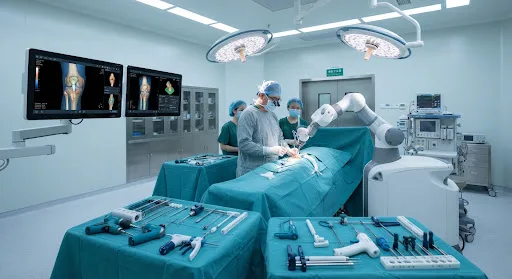
A clean, state-of-the-art orthopedic operating room in a Grade 3A Chinese hospital, featuring surgical robots, dual monitors displaying precise 3D knee joint navigation, sterile teal surgical drapes, soft overhead clinical lighting, and high-precision instruments in shades of deep cyan and calm white.
Figure 1: Digital joint-replacement center at a leading Chinese public Class-A tertiary orthopedic hospital (equipped with orthopedic surgical robot navigation systems) Standardized digital orthopedics
02

The Biggest Line Item: Fully Transparent Implant Costs (Import vs Chinese Brands)

In the total bill for knee replacement surgery (TKA / total knee arthroplasty), the artificial joint implant — femoral component, tibial tray, ultra-high-molecular-weight polyethylene liner, patellar component and more — is by far the most significant share. Since China launched its national centralized volume-based procurement (VBP) for high-value medical consumables, joint implant costs have been structurally reset.

Reference VBP price ranges at public hospitals: mainstream joint implant brands (import & domestic) Data basis: 2025–2026 China pharmaceutical information platform consumable database
Implant category & brand tier Main material & design VBP listed range, China Class-A tertiary EU/US or private non-VBP comparison
Global tier-one import brands
Stryker / DePuy Synthes (Johnson & Johnson) / Zimmer Biomet / Smith & Nephew
Highly cross-linked polyethylene liner + cobalt-chromium-molybdenum alloy / oxidized-zirconium ceramic surface
USD 1,000 ~ 1,900
$12,000 ~ $25,000 USD
Typically 8–12 times the Chinese public-hospital price
Leading mature Chinese brands
AK Medical / Chunli (Beijing Chunlizhengda) / WEGO Ortho
3D-ACT bio-porous titanium alloy tibial tray + wear-resistant cross-linked polyethylene
USD 710 ~ 1,200
$6,000 ~ $10,000 USD
Resale prices in some developing countries overseas
lightbulb Attending specialists' advice: how should you choose your implant?
Patient age & activity demands For patients under 60 who want deep squatting, stair climbing or outdoor sports, attending surgeons typically recommend a highly cross-linked polyethylene liner with a wear-resistant ceramicized femoral component — balancing wear resistance with an ultra-long service life.
Bone density & ligament stability Patients with osteoporosis or a deficient posterior cruciate ligament need an individualized posterior-stabilized (PS) design or high-flexion cut geometry. Leading Chinese and import manufacturers both deliver equivalent levels of stability.
Metal allergy screening For the rare patient allergic to nickel or cobalt-chromium alloys, the Class-A tertiary orthopedic department can customize or source an implant with a titanium-niobium-nitride or fully oxidized-zirconia surface modification — with special stock arranged two weeks in advance.
03

Item-by-Item Breakdown of Out-of-Pocket Surgery, Anesthesia & Inpatient Costs

Beyond the implant itself, knee replacement involves perioperative lab testing and evaluation, the surgeon's technical fee, anesthesia monitoring and early bedside physical therapy (PT). Below is the standard out-of-pocket cost model used by China's leading public Class-A tertiary hospitals:

1. Preoperative workup & 3D digital reconstruction navigation

Includes full-length weight-bearing X-rays of both lower limbs, thin-slice spiral CT 3D bone modeling of both knees, cardiopulmonary function testing and lower-limb deep-vein ultrasound screening.

USD 300 ~ 620
2. Chief-physician surgeon's fee & combined spinal-epidural / general anesthesia

Priced under China's nationally standardized fee codes. Covers the lead surgeon for this major operation, intraoperative ultrasound-guided adductor-canal (saphenous) nerve block analgesia and continuous vital-signs monitoring.

USD 670 ~ 1,300
3. Enhanced recovery (ERAS) pathway, early physical rehab & thrombosis prevention

Walker-assisted mobilization guidance 6 hours after surgery, CPM (continuous passive motion) therapy, intermittent pneumatic compression (IPC) and low-molecular-weight heparin anticoagulation.

USD 330 ~ 590
4. Ward bed & nursing costs (typical discharge in 4–6 days)

A standard twin room at a public Class-A tertiary hospital is about USD 18 ~ 39/day; an international medical department / VIP private room runs about USD 120 ~ 270/day (with a companion bed).

USD 180 ~ 1,300
Depends on room type & length of stay
Total budget benchmark — public Class-A tertiary, single knee
USD 3,700 ~ 6,700

About 3,500 ~ 6,500 USD (covering a leading import implant, surgery & general anesthesia, bed and the full ERAS recovery cycle)

A dedicated modern rehabilitation gym within an international medical department of a hospital, an elderly patient supported by a physical therapist practicing walking with parallel bars, gentle sunlight streaming into the spacious clinical recovery room, professional and warm atmosphere.
Figure 2: ERAS early-mobilization rehab room at a Chinese public Class-A tertiary hospital (walker-assisted walking achieved on the first day after surgery) Standardized physical therapy (PT)
04

International Private Health Insurance (BUPA, MSH, Allianz & More): Reimbursement & Direct Billing

Patients holding international commercial health insurance or high-net-worth global medical plans can enjoy smooth direct billing and after-the-fact claims at the international medical departments of China's leading public Class-A tertiary hospitals.

Major insurers covered under direct-billing networks

The international medical departments of China's top public Class-A tertiary hospitals (such as Peking Union Medical College Hospital, West China Hospital of Sichuan University, Zhongshan Hospital of Fudan University, the First Affiliated Hospital of Sun Yat-sen University, etc.) typically hold direct-billing authorization (GOP) with the following third-party TPA organizations:

BUPA MSH Allianz Cigna AIA
The three essential documents for your claim

For patients who self-pay and claim back home, MedTravel China's dedicated bilingual medical liaisons will, at discharge, arrange a complete set of standardized English documents that meet overseas insurers' audit requirements:

  • task_alt Itemized daily inpatient charge statement (including consumable barcodes and lot numbers)
  • task_alt Discharge summary and operative record (signed by the operating surgeon and stamped with the medical records seal)
  • task_alt National-standard electronic VAT medical fee invoice
05

Why Does MedTravel China Charge a Flat 300 USD Coordination Fee?

Cross-border healthcare is not an ordinary travel-agency business. To protect patients' interests, MedTravel China has followed a “three-zero principle” since day one — zero medical markup, zero drug rebates, zero implant commissions — and charges only the standardized upfront service fee of 300 USD.

translate
Professional bilingual medical record reconstruction

Medical translators with clinical backgrounds convert your local X-ray and MRI reports and medical history into a written case summary that meets the standards of Chinese Class-A tertiary orthopedics.

psychiatry
48-hour pre-review by senior Class-A tertiary experts

Your file goes straight to the chief physician of our partner public orthopedic department to assess whether you qualify for partial (unicompartmental) knee replacement (UKA) or total knee replacement (TKA) — so you never fly to China on a guess.

meeting_room
Priority bed intention & surgery scheduling

We coordinate a bed in the international medical department of a public hospital and lock in your surgeon's team operating slot, so you are admitted seamlessly on arrival — no weeks-long outpatient waiting list.

flight_takeoff
S2 medical visa & official invitation letter assistance

The public hospital officially issues an invitation letter describing your treatment itinerary, guiding you and your family to obtain the S2 medical (medical-treatment) visa quickly, plus entry-exit health declaration clearance.

verified
Not eligible for surgery? Full-refund guarantee If the Class-A tertiary orthopedic experts determine that severe underlying complications or contraindications make surgery unsuitable for you, the platform refunds your coordination fee via the original payment method after deducting only the necessary imaging-retrieval costs.
Read the refund policy →
Article tags: Knee replacement VBP implants Public hospital costs 300 USD coordination fee
receipt_long Cost of Treatment in China: the 7 fees you'll actually pay arrow_forward
Zero medical markup Fully transparent consumable codes, verifiable by listing number

Ready to find a world-class, high-value Class-A tertiary solution for your knee in China?

For just 300 USD, receive a 48-hour feasibility pre-review from China's top orthopedic specialists and a precise cost breakdown. Every medical bill is settled by you directly at the hospital — never through any intermediary margin.

info Medical information on this site is for general reference only and does not constitute medical advice, diagnosis, or treatment recommendations. Actual care decisions rest with the licensed physicians of the hospital.

helpFrequently asked questions

Why do quoted knee replacement prices in China differ so much between hospitals?expand_more

Three variables explain most of the gap: which implant you receive and whether it sits in the national volume-based procurement (VBP) list, whether the quotation is the implant alone or the full inpatient episode, and whether the patient is billed as a standard inpatient or through the international medical department. Ask for the implant category, the inpatient episode total and the billing channel in writing before comparing two hospitals.

What is the 300 USD fee, and is it part of the hospital bill?expand_more

It is the MedTravel China pre-review coordination fee, paid to us, not to the hospital. It covers the manual review of your records, the feasibility assessment with the department and a written cost breakdown. Hospital charges are a separate matter and are invoiced to you directly by the hospital — we take no margin on them.

Are there hidden costs after I arrive in China?expand_more

The ones that surprise patients are pre-operative tests the local reports could not substitute for, revision-related implants if the intra-operative findings differ from the plan, and extended stay days. We ask the department to state which re-tests are expected and how long the typical inpatient stay is for your kind of case, so the estimate you receive before travelling accounts for them.

gavelSource & verification

  • chevron_rightEditorial basis: publicly released results of the national volume-based procurement (VBP) of artificial joint implants, and public hospital price-transparency information supervised by the National Health Commission and provincial pricing authorities.
  • chevron_rightQuoted price ranges are public reference ranges only. What you actually pay depends on your implant category, your inpatient episode and the billing channel, and is set by the hospital's published prices at the time of treatment.

verifiedVerified by MedTravel China on2026-10-13