

Serious Legal Red Lines: Debunking the Illegal Promises of Foreign "Brokered Organ Sales"
Highest Legal Warning: Foreign-Related Organ Trading Is an International Crime
Any overseas black-market broker claiming that "for just a few hundred thousand US dollars you can be quickly matched with a kidney in China and skip kinship review" is suspected of the crime of organizing the sale of human organs (Article 234a of the Criminal Law of the People's Republic of China) and aggravated cross-border telecom fraud. Every legitimate organ transplant system in a public Class-A tertiary hospital is uniformly governed by the national computer system for organ allocation; no institution or individual can interfere with it or buy and sell through it.
Under the Regulations on Human Organ Donation and Transplantation, promulgated by Order No. 767 of the State Council of the People's Republic of China, China has established a fully end-to-end traceability system for organ donation and transplantation. The Regulations expressly provide: no organization or individual may buy or sell human organs in any form, or engage in any activity related to the buying and selling of human organs. Disguised organ trading under any label — brokering, medical tourism, research sponsorship, or otherwise — is strictly prohibited.
account_balance National-Priority Principle of the Deceased Organ Donation (DCD) System
China's human organ allocation and sharing computer system (COTRS) performs fully automated matching based on scientific scoring models (degree of match, medical urgency, waiting time, etc.). China's health administration regulations state in plain writing, without ambiguity:
No foreign citizen who does not hold Chinese nationality may ever be entered on China's waiting list for organ transplant recipients, and public medical institutions are absolutely prohibited from transplanting organs voluntarily donated after death to foreign patients.
Foreign-related forgery of kinship documents and collusion with black-market brokers are referred directly to China's public security organs for case filing and criminal investigation; participants face long-term imprisonment and deportation.
The Only Lawful Route: Statutory Requirements for Living-Donor Kidney Transplant Between First-Degree Relatives or a Spouse
For overseas patients with end-stage renal failure (uremia), the sole statutory precondition for receiving a kidney transplant in China is: the recipient brings along a donor who qualifies under Chinese law as a first-degree relative, and the donor voluntarily donates a single kidney while living, on the basis of a kinship relationship certified by official notarization of both China and the donor's home country.
Spouse
Married 3+ years or has a child togetherBoth parties must be lawfully registered as married. Couples married for less than three years must provide the medical birth certificates of children born of the marriage, together with substantive evidence that a genuine marital relationship has continued over a long period.
Direct Blood Relative
Between parent and childA biological parent may donate to his or her child, or an adult child may donate to a parent. A rigorous STR-locus parentage DNA test must be completed at a genetics-identification institution accredited by the Chinese judicial authorities.
Collateral Blood Relative Within Three Generations
Siblings / other close collateral kinLiving donation between full siblings requires a court-grade co-ancestry genetic report covering two or more generations proving a shared paternal or maternal line, and the home country must issue a detailed household-registration history chain.
clinical_notes Statutory Medical and Psychological Safeguards for the Donor
The paramount review objective of China's ethics committees is to ensure that a living donor's right to life, health and informed consent is absolutely inviolable; under no circumstances may a donor's long-term health be compromised:
| Assessment Dimension | Statutory Standard and Threshold | Exclusion and One-Vote-Veto Indicators |
|---|---|---|
| Age and Civil Capacity | At least 18 years old and generally no older than 60, with full civil capacity | Minors, persons with severe intellectual disability, or persons with limited civil capacity are absolutely excluded |
| Renal Functional Reserve | Radionuclide measurement of dual-kidney GFR (glomerular filtration rate) > 80 mL/min/1.73 m² | Unilateral renal hypoplasia, persistently abnormal microalbuminuria, occult nephritis |
| Systemic Baseline Metabolism | No diabetes (normal OGTT), controlled normal blood pressure, no active infection | Refractory hypertension with target-organ damage, BMI > 32 severe obesity, active hepatitis |
| Independent Psychological Interview | Independent, undisturbed interview in the clinical psychology department of a Class-A tertiary hospital with a signed in-depth voluntary informed-consent form | Detected family coercion or pressure, uncontrolled depression or anxiety, or indications of financial-deal expectations |
The Five-Step Closed-Loop Process of Cross-Border Ethics Approval and Dual Notarization & Legalization
Approval of foreign-related living-donor organ transplantation operates under a "one-vote-veto system of procedural justice." Any single defect in a notarial certificate, any abnormal genetic marker, or any question raised by an ethics committee member brings the approval to an immediate halt. The following is the five-step closed-loop statutory procedure coordinated by MedTravel China:
assignment Step 1: Home-Country Notarial Certificate of the Direct-Relative Relationship and Cross-Border Dual Legalization (Apostille / Consulate)
Takes about 2–4 weeksThe patient and the donor must obtain a notarial certificate of the direct relative relationship (or a notarized marriage certificate) from a notary authority in their home country, accompanied by official supporting documents such as original birth certificates and household-register records. After authentication by the home country's foreign affairs authorities, the documents must be submitted to the Chinese embassy or consulate in that country for consular legalization (states party to the Hague Convention instead obtain an Apostille certificate). During the initial review phase, MedTravel China can already help overseas families verify whether their notarial certificate templates are valid.
biotech Step 2: Strict Medical Pre-Screening of Tissue Typing and HLA Antibody Compatibility at a Public Class-A Tertiary Organ Transplant Center
Takes about 3–5 business daysImmediately after arriving in China, the parties are admitted to the dedicated organ transplant unit of the designated national public Class-A tertiary hospital. Testing covers ABO blood-group compatibility, panel-reactive antibody (PRA) screening, high-resolution human leukocyte antigen (HLA) typing, and the complement-dependent cytotoxicity (CDC) crossmatch, to confirm that there is no risk of hyperacute rejection or irreversible severe immune incompatibility between donor and recipient.
fingerprint Step 3: Kinship DNA Verification Review at a Judicial Appraisal Institution (Independent Sampling Inside China)
Takes about 5–7 business daysCivil DNA reports issued outside China carry no direct legal effect in China's clinical approval process. Both parties must go to a third-party judicial appraisal institution registered with China's judicial administration departments, where two certified forensic medical examiners supervise the entire process on video, verify the biometric information in the passports, and collect blood samples on site, before issuing a formal kinship report with the legal effect of "forensic biological evidence judicial appraisal" (the exclusion probability must reach 99.999% or above).
groups Step 4: Independent Full-Committee Inquiry by the Hospital Ethics Committee for Clinical Application of Human Organ Transplantation
Statutory closed-door review sessionAn independent ethics committee composed of medical experts, legal representatives, sociologists, ethics scholars and foreign-affairs officers sits in review. The recipient and the donor are questioned separately, each entering the hearing alone, with native-language court-grade simultaneous interpretation and full high-definition audio-video recording archived. The committee focuses on verifying the donor's motives, confirming that the donor fully understands the potential health risks of removing one kidney, and strictly preventing family pressure or involuntary donation. Passage requires a written secret-ballot vote in favor by at least two-thirds of the committee members.
admin_panel_settings Step 5: Final Statutory Review and Administrative Filing by the Provincial Health Administration for Cross-Border Care
Final approval in effectThe hospital submits the complete set of notarized and legalized originals, the judicial DNA report, the medical compatibility records and the hospital ethics approval to the provincial health commission (the division administering foreign-related organ transplantation). Only after verification through the official dedicated network and issuance of the administrative license may the surgical team perform the living-donor kidney transplant for the patient.
End-Stage Renal Disease (ESRD) Alternatives: High-Quality Blood Purification and AV Fistula Vascular-Access Centers
If you cannot find a donor who meets the statutory kinship requirements in your home country, never risk the black market. China's leading public Class-A tertiary kidney centers operate at an internationally high level in the quality of maintenance hemodialysis, the establishment of complex vascular access, and integrated TCM-Western approaches that slow the decline of residual kidney function, sustaining a high-quality life for patients over years or even decades.
High-Flux Hemodialysis (HDF)
Ultrapure dialysate technology with large-pore high-flux polysulfone membrane dialyzers, combined with on-line hemodiafiltration (on-line HDF), powerfully clears beta-2 microglobulin and middle- and large-molecular-weight toxins, markedly reducing the incidence of dialysis-related amyloidosis and peripheral neuropathy.
Complex Vascular Access Salvage (AVF)
Class-A tertiary vascular surgery departments provide microvascular anastomosis and ultrasound-guided percutaneous transluminal angioplasty (PTA), targeting vascular occlusion caused by diabetic gangrene, thrombosis of high-position prosthetic arteriovenous grafts (AVG), and recurrent fistula failure.
TCM-Coordinated Kidney Preservation Therapy
Prescription formulas from the national key clinical specialty in TCM nephrology: colon dialysis combined with high-position retention enemas of Chinese herbal medicine and acupoint application to regulate water-salt metabolic disturbances, effectively correcting refractory skin pruritus, loss of appetite and severe anemia while protecting residual glomerular filtration rate.
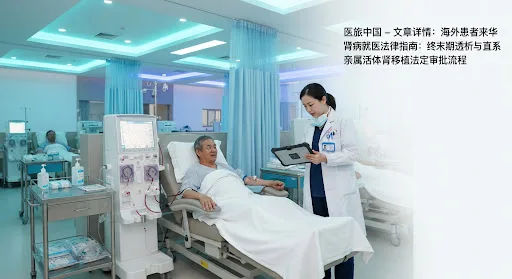
Internationally Standardized Blood Purification Center with Rigorous Infection Control
Separate isolation dialysis units for hepatitis B, hepatitis C, HIV and syphilis, with short-stay dialysis arrangements for visiting international patients
MedTravel China's Cross-Border Compliance Assistance Scope and the 300 USD Pre-Review Mechanism
Foreign-related kidney transplant is the field of cross-border care with the highest legal risk and the most demanding ethics review. To stop overseas patients from blindly booking flights to China before legal compliance and tissue-match feasibility are established — only to suffer irrecoverable financial loss — MedTravel China offers the 300 USD joint pre-review mechanism for kidney disease and transplant law and medicine.
300 USD Remote Dual-Track Legal and Clinical Pre-Review
Jointly issued by the organ transplant director team of a public Class-A tertiary hospital experienced in cross-border cases, together with a cross-border health law compliance specialist.
Notice: MedTravel China does not act as a broker or reseller and does not interfere with hospital ethics-committee decisions. The 300 USD service fee corresponds to the translation of overseas medical case files, bilingual verification of legal provisions, and expert working time. If legal verification finds any doubt about the kinship or any situation that falls outside the statutory relative requirement, we will immediately stop processing the case and truthfully inform the patient of the legal risk.